

Hip-Hop Vocal Mixing: Building Clarity, Weight and Presence
Build clear, controlled hip-hop vocals that remain powerful against the beat while preserving the artist’s delivery, doubles, ad-libs and character.
In hip-hop, the lead vocal often carries the rhythm, personality and centre of the record at the same time. It must feel present without becoming painfully bright, controlled without losing aggression and clear without floating above the beat.
That result rarely comes from one “rap vocal preset.” The production, microphone, performance, room, arrangement and delivery all influence the mix. A useful vocal chain supports the artist’s intention; it does not replace a strong recording or a clear balance.
Start with the performance and recording
Before adding plugins, listen to the raw lead vocal at a comfortable level. Check:
- whether the delivery remains consistent between sections;
- if loud words are clipped or distorted;
- room tone and background noise;
- headphone spill;
- plosives and harsh sibilance;
- editing clicks;
- doubled words that do not align as intended; and
- whether the chosen take carries the right attitude.
A distorted recording cannot be fully repaired by turning it down. If an important line is damaged and the artist can reproduce it, a short re-record may be more honest than heavy restoration.
Do not remove every breath or rough edge. Hip-hop vocals often depend on momentum and physical presence. Clean what distracts from the performance while protecting the details that make the artist recognisable.
Our vocal-preparation checklist explains how to identify recording problems before the mix begins.
Build the balance before the chain
Place the vocal against the instrumental with only basic gain. If it disappears completely, determine what is masking it.
The problem may be:
- an over-bright melody occupying the same upper midrange;
- a snare or hi-hat pattern competing with consonants;
- dense instruments filling the vocal’s core frequencies;
- excessive low-mid buildup;
- a beat that is already heavily limited; or
- vocal level changing dramatically from line to line.
Do not force the vocal forward only by boosting high frequencies. Sometimes the better move is to create a small amount of space in the instrumental, automate the vocal or control one competing element.
A clear mix is a relationship, not a soloed vocal tone.
Control level in more than one stage
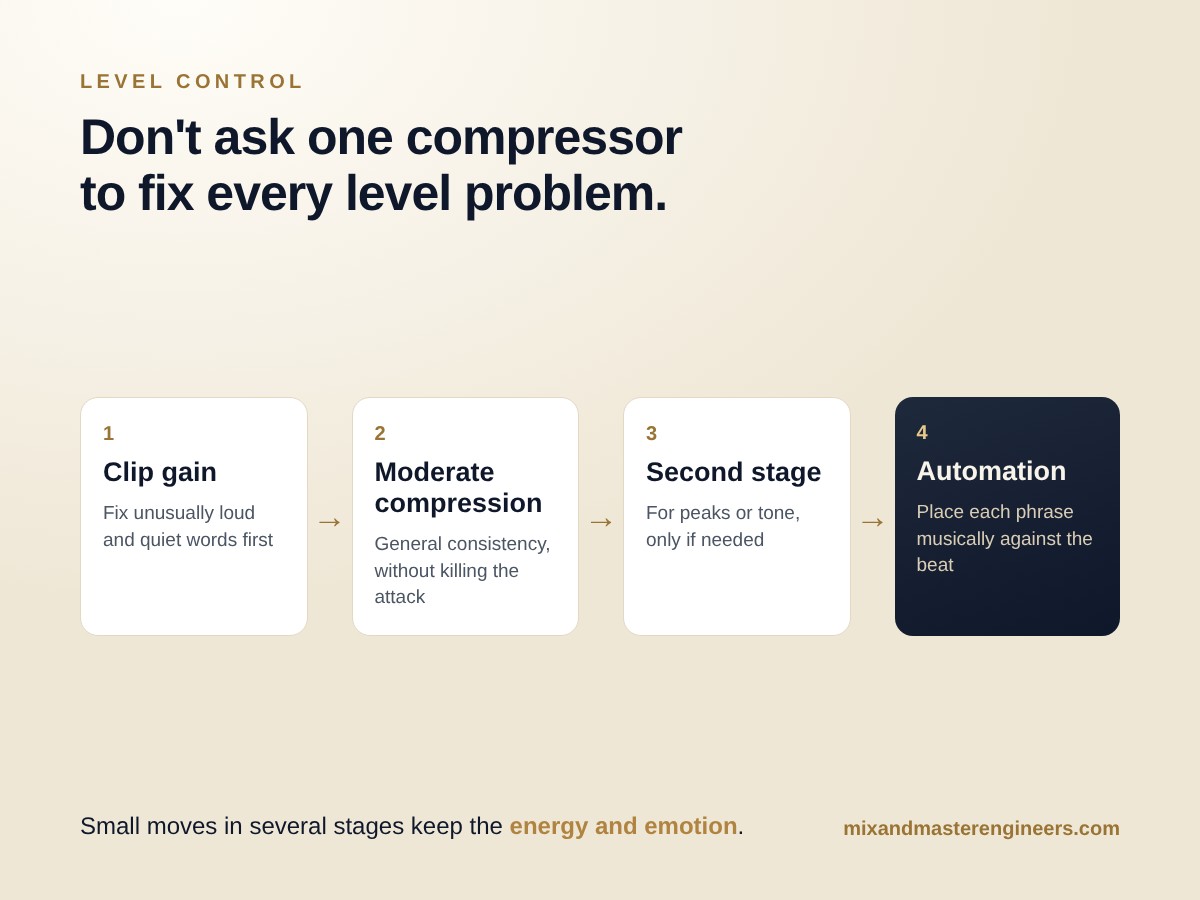
Rap performances can move quickly between quiet syllables, sharp consonants and loud accents. One aggressive compressor may hold the vocal still but remove the attack and emotion.
A more controlled approach may combine:
1. clip gain or volume editing for unusually loud and quiet words; 2. moderate compression for general consistency; 3. a second stage for peaks or tone, if needed; and 4. automation to place phrases musically against the beat.
The order depends on the recording. The principle is to avoid asking one processor to solve every level problem.
Compression settings should respond to the performance. A fast attack can control peaks but may soften consonants. A slower attack can preserve energy but allow sharp transients through. Release time affects whether the vocal recovers naturally between words or pumps against the rhythm.
Listen in context rather than choosing settings from a list.
Shape tone without removing identity
Equalisation should solve a specific issue. Begin by asking what prevents the words from feeling clear.
Low frequencies and low mids
Remove rumble that does not belong to the voice, but do not automatically high-pass until the vocal becomes thin. Male and female voices can both contain useful weight below the frequencies people expect.
Boxiness or congestion may live in the low mids, particularly when the room is audible. Use controlled moves and compare with the instrumental. A frequency that sounds unpleasant in solo may help the vocal feel solid in the mix.
Presence
The upper midrange helps intelligibility but can become harsh quickly. If the vocal needs more presence, first check whether guitars, keys, synths or percussion are masking it.
A small cut in a competing instrument can sound more natural than a large boost on the voice.
Air
High-frequency “air” can make a vocal feel expensive and open, but it also increases sibilance, mouth noise and room sound. Add it only when the recording supports it.
Treat sibilance as a moving problem
“S” and “T” sounds do not remain at one exact frequency throughout a performance. A de-esser or dynamic equaliser can reduce them when they become distracting without dulling every word.
Listen after compression and high-frequency boosts, because those processes may make sibilance more obvious. If one syllable is much sharper than the rest, manual automation can be cleaner than forcing the entire vocal through stronger de-essing.
The goal is intelligibility without pain, not the removal of every consonant.
Decide what doubles and ad-libs should do
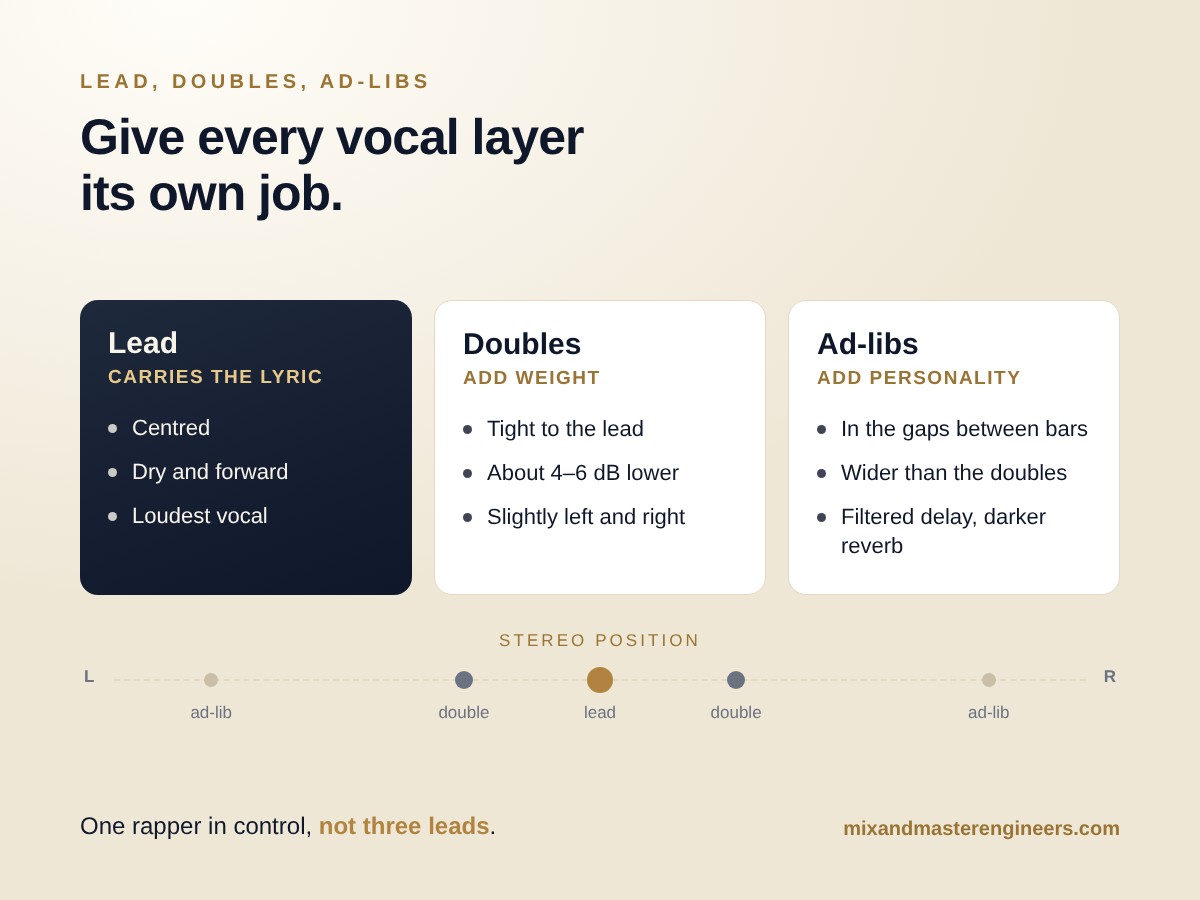
Doubles can add weight, width or urgency. Ad-libs can create conversation, movement and personality. They should not compete with the lead for every word.
Useful decisions include:
- keeping important doubles near the centre for impact;
- widening selected layers for contrast;
- filtering or darkening ad-libs so the lead remains dominant;
- automating entries rather than leaving every layer at one level;
- using shorter ambience on fast lines; and
- muting unnecessary overlaps.
Timing does not need to be mathematically perfect. Tighten parts that blur the message, but preserve deliberate looseness when it creates energy.
Use saturation for density, not destruction
Saturation can help a vocal feel fuller and more stable on small speakers. It may also emphasise grit and consonants. Use it in context and level-match the processed signal before deciding it is better.
Parallel saturation is useful when the clean vocal should retain its shape while an additional layer provides density. Filter the parallel path if low-mid buildup or harshness increases.
Distortion can also be a creative identity. If the artist supplied a printed effect that defines the hook, preserve it and request a dry alternative rather than deleting the production choice.
Choose space that supports the rhythm
A long reverb can push a vocal behind the beat. A completely dry vocal may feel disconnected from the production. The correct space depends on tempo, arrangement and intention.
Options include:
- a short room or plate for connection;
- a timed delay that fills gaps without washing over words;
- a filtered throw on selected line endings;
- a longer effect automated only for transitions; or
- separate ambience for lead, doubles and ad-libs.
Filter the return so low frequencies do not cloud the centre and high frequencies do not exaggerate sibilance. Automate effects with the arrangement rather than leaving them static.
Make room for the vocal in the beat
When the beat arrives as one stereo file, control is limited. Avoid destroying it with extreme equalisation. Dynamic EQ or carefully automated processing may create small amounts of space during vocal phrases.
When multitracks are available, the mixer can work more selectively. A melody may move slightly behind the vocal, the snare brightness can be controlled, or a bass layer can be shaped without changing the entire instrumental.
Send the beat producer’s rough mix as a reference. It may contain balances and effects that are important to the record.
Check translation at realistic levels
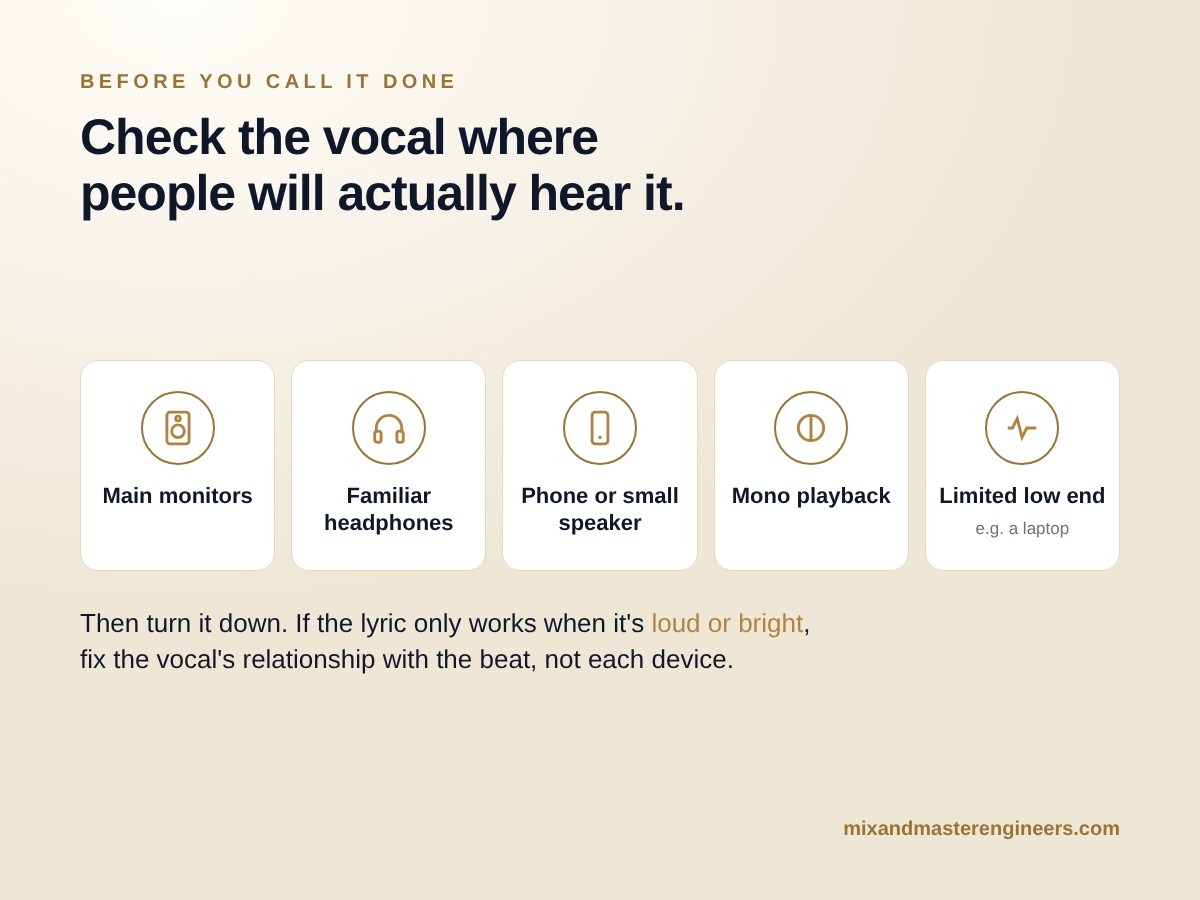
A powerful vocal should remain understandable when the mix is quiet. Low-level listening reveals whether the voice depends on brightness or volume alone.
Check on:
- the main monitors;
- familiar headphones;
- a small speaker or phone;
- mono playback; and
- a system with limited low-frequency extension.
Do not make a separate mix for every device. Look for repeated problems and solve the relationship causing them.
Frequently asked questions
Should rap vocals always be heavily compressed?
No. Some performances need firm control; others lose excitement when over-compressed. Use editing, compression and automation together according to the delivery.
Should the lead vocal be louder than the snare?
There is no universal numerical relationship. The vocal must communicate clearly while the drums retain impact. Judge the balance across the whole record.
Do I need expensive plugins for a professional result?
No single plugin guarantees a professional vocal. Recording quality, decisions, monitoring, automation and experience matter more than owning a particular chain.
Should I send tuned and untuned vocals?
Send the approved tuned version when tuning is part of the production. If possible, include a clearly labelled untreated alternative and explain whether further tuning is required. Read our guide to natural vocal tuning and the Auto-Tune effect.
From the studio: where the ad-libs and doubles go
The lead verse is rarely what makes a rap vocal hard to mix. The trouble usually starts with everything around it. Doubles, ad-libs and hype tracks often arrive at the same level as the lead, all panned to the centre. The words start to smear together and the main voice loses its edge.
My first step is to give each layer a job. The lead stays centred and clear. Doubles sit lower and often get a little more top-end cut so they add weight without fighting the consonants. Ad-libs move out to the sides, and some get a short delay or a filter so they feel like part of the scene, not a second lead.
This changes with the style. In trap, the 808 takes a lot of space, so I keep the vocal low mids tidy. In drill, the delivery is often darker and I protect that mood rather than brightening it too much. Even after 15+ years of hip-hop sessions, I still check the hook on phone speakers before I call it done.
One session where the layers got in the way
On one hip-hop mix, the rapper's main vocal had the right attitude and clarity, but the doubles and ad-libs were crowding it, especially in the hook and the last four bars of each verse. The doubles were too loud and not tight enough to the lead, so every consonant landed twice. The ad-libs were too central and too dry. The record felt like three competing lead performances instead of one rapper in control.
I fixed it in stages:
1. Timing first. I edited the doubles against the lead and tightened the starts and ends of key words, so there was no flam on the consonants. 2. Level. I used clip gain and automation to pull the doubles back about 4–6 dB, letting them rise only on punchlines, end words and selected emphasis lines. 3. Tone and width. I filtered more low end and some presence out of the doubles, compressed them harder than the lead, de-essed them more aggressively and panned them slightly left and right. The lead stayed dry, centred and forward, so the doubles became a controlled layer around it rather than a second lead. 4. Ad-libs. I kept only the most effective ones, automated them into the spaces between bars, sent them wider than the doubles, and gave them a filtered delay and a darker reverb so they answered the rapper without stepping on his words.
By the final mix, the hook still felt aggressive and layered, but every bar of the lead came through clearly. The ad-libs added personality and the doubles added size.
Build presence without erasing the artist
The best hip-hop vocal mix does not make every rapper sound the same. It creates enough control and space for the individual delivery to lead the record.
If you need help balancing leads, doubles and ad-libs against a finished beat or full multitrack production, contact Mix & Master Engineers. You can review our vocal production service, explore professional mixing, hear before-and-after examples and compare packages.
Clarity, weight and presence are not separate presets. They are the result of decisions that respect the performance and the beat together.
Keep reading
- Natural tuning versus the Auto-Tune effect on rap vocals
- How to prepare vocal tracks for a mixing engineer
- Trap mixing and mastering
- Hip-hop mixing for artists in Atlanta
- Boom bap mixing and mastering
---
About the author: Charles "DGUNZ" Alison is the lead mixing and mastering engineer at Mix & Master Engineers, with 15+ years of experience across hip-hop, Afrobeats, gospel, R&B, pop and more. He trained at Point Blank Music School (UK), is an approved Apple Digital Masters provider, and is a Top Rated, Vetted Pro engineer on Fiverr with 2,200+ client reviews. Meet the engineer · Contact the studio