

How Long Does Mixing and Mastering Take? A Release-Planning Guide
Plan your release with a realistic understanding of mixing, mastering, revisions, rush delivery and the project details that affect turnaround time.

A release date is exciting until the final mix, master, artwork, distribution and promotion all compete for the same few days. Mixing and mastering should not be treated as one instant export at the end of production. Each stage includes listening, decisions, communication and quality control.
There is no honest universal promise that every song will be finished in the same number of hours. A clean, approved production can move quickly. A disorganised session with unresolved vocals, missing files and daily arrangement changes cannot.
This guide explains what affects professional mixing and mastering turnaround time, how revisions fit into the schedule and how independent artists can plan without sacrificing the record.
Mixing time and mastering time are not the same
Mixing works with the individual parts of the song. The engineer balances levels, shapes tone, manages dynamics, builds depth and helps the vocal, drums, bass and musical layers work together. If editing, vocal tuning, drum replacement or production changes are requested, those tasks add a separate layer of work.
Mastering starts after the mix has been approved. It evaluates the finished stereo mix, controls final tone and dynamics, checks translation and prepares suitable delivery files. Mastering cannot efficiently begin while the artist is still changing vocal timing, replacing a snare or requesting a new arrangement.
For that reason, the useful sequence is:
1. Finish production and editing. 2. Deliver complete, tested files. 3. Complete the mix and revisions. 4. Approve the mix. 5. Master the approved mix. 6. Check final files before distribution.
Trying to overlap every stage may feel faster, but it often creates version confusion.
What affects the mixing turnaround
The number and condition of the tracks
A compact, clearly labelled session is quicker to assess than a folder containing duplicate exports, unnamed audio and several uncertain vocal takes. Track count alone is not the whole story. Forty organised tracks can be easier than twenty files that do not align.
Before delivery, remove unused material from the delivery copy, use one common start point and test the exports in a blank session. Our guide to preparing and exporting stems explains the full process.
Editing and tuning requirements
Mixing, editing and production are related but different services. If the lead vocal needs comping, breath editing, detailed timing and pitch correction, confirm that work before the schedule is agreed.
The same applies to drum editing, noise repair, sample replacement and arrangement changes. None of these requests is wrong; they simply require time and should not appear halfway through a job as an unplanned assumption.
Creative direction
A clear reference and two or three priorities help an engineer start in the right direction. “Make it professional” is not a complete brief. Explain whether the vocal should feel intimate or aggressive, whether the drums should be natural or highly controlled, and which production effects are essential.
References communicate scale and intention, but they do not turn a different recording into an identical record. Choose examples for specific reasons: vocal level, low-end weight, width, atmosphere or dynamics.
Engineer workload and project complexity
Professional studios schedule several clients and leave time for focused listening. A quoted turnaround normally begins after the studio has received the complete delivery and confirmed that the project is ready—not from the first message asking about availability.
Albums and EPs also require continuity between songs. The engineer may need to compare tracks repeatedly so the project feels connected without forcing every mix to sound the same.
What affects the mastering turnaround
Mastering can be quicker than mixing because it works from approved stereo files, but it still needs proper checks. The engineer may request a mix revision if clipping, vocal balance, low-end instability or an exposed edit cannot be solved responsibly at the stereo stage.
Multiple versions add time. A release may need:
- the main master;
- an instrumental;
- a clean version;
- an a cappella;
- a performance track;
- a radio edit;
- a vinyl premaster; or
- alternate sample-rate or bit-depth deliveries.
List those requirements before mastering begins. Creating them after approval can require reopening the mix and repeating quality control.
Revisions belong in the schedule
A revision is a focused response to an approved first mix, not a new production session. Good feedback explains what is heard, where it occurs and what outcome is preferred.
Instead of “the chorus needs more energy,” try: “At 1:12, can the lead vocal sit slightly further forward and can the snare feel more present without making the cymbals brighter?”
Collect feedback from decision-makers before sending it. Separate messages from an artist, producer and manager can conflict and create unnecessary rounds.
Allow time to listen on a few familiar systems, but avoid comparing endlessly at radically different volumes. Decide which comments genuinely improve the record and send one organised revision note.
Why rush delivery can carry risk
A rush service compresses the calendar; it does not remove the need for listening, communication or file checks. Availability must be confirmed before the deadline is promised.
Rush work is most realistic when:
- the arrangement and performances are approved;
- all files are complete and correctly labelled;
- references and notes are concise;
- one person controls feedback;
- additional editing is limited; and
- the required deliverables are known in advance.
It becomes risky when a release date is used to force unfinished production through mixing and mastering. No amount of urgency can restore a clipped recording or locate a missing lead vocal.
Our standard turnaround times
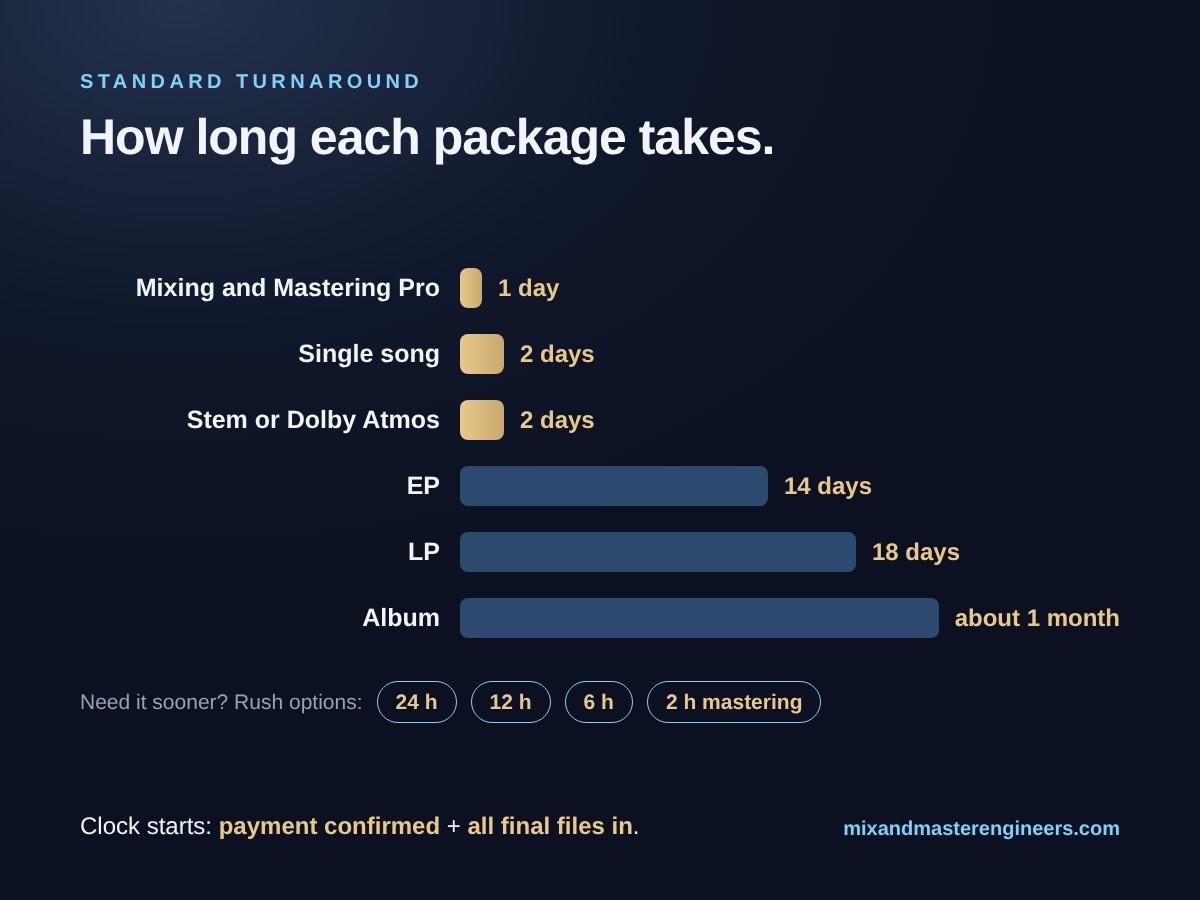
Here are the standard delivery times for our packages. The clock starts once payment is confirmed and we have every final file:
- Single song (mixing, mastering, or mixing and mastering): 2 days
- Mixing and Mastering Pro: 1 day
- Stem mastering and Dolby Atmos mixing or mastering: 2 days
- EP: 14 days
- LP: 18 days
- Album: about 1 month
Need it sooner? Rush delivery can be added at checkout: 24 hours, 12 hours or 6 hours, plus a 2-hour option for mastering. Compare everything on our packages and pricing page.
A practical independent-release timeline
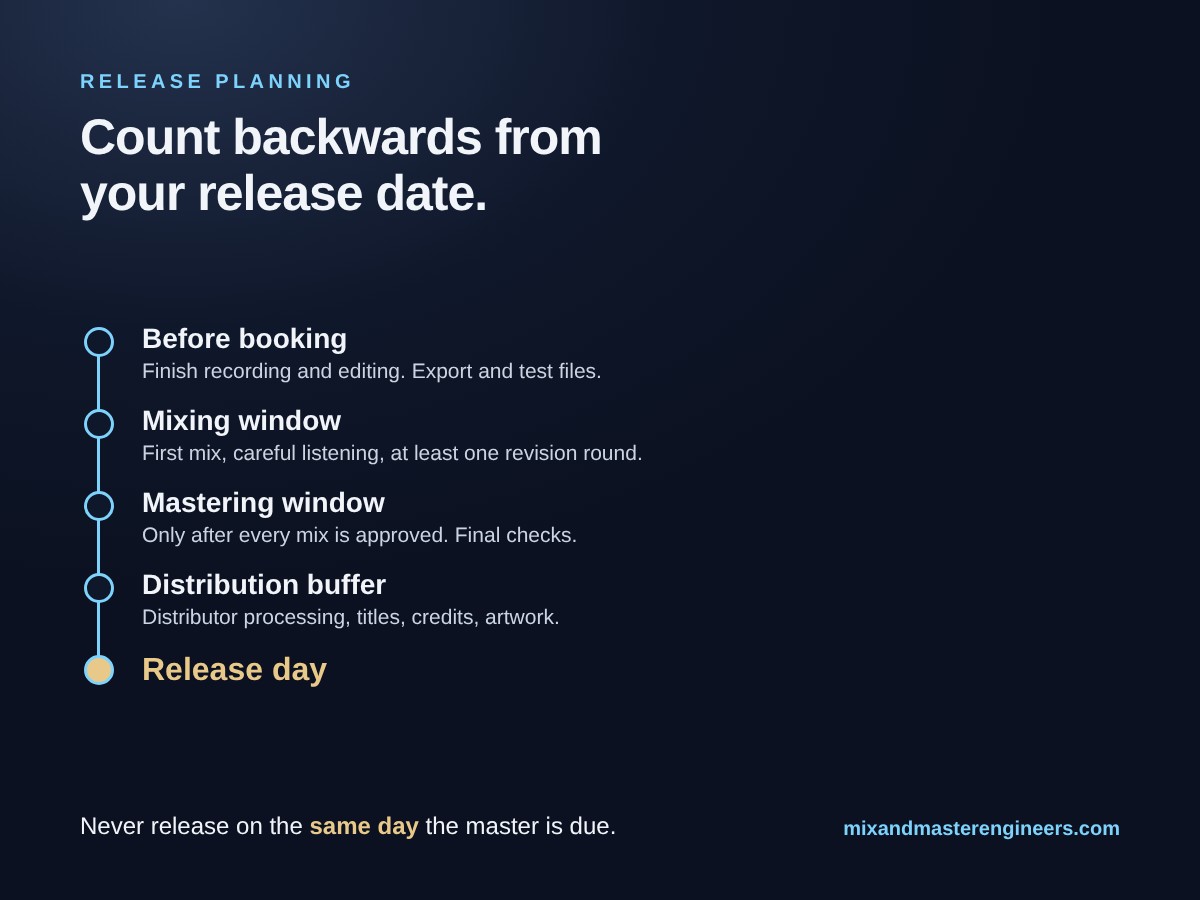
Every project differs, but the following order creates breathing room:
Before booking
Finish recording, production and editing. Request the studio’s delivery requirements. Export and test the files. Confirm the songs, versions and release plan.
Mixing window
Leave space for the first mix, careful listening and at least one organised revision stage. Albums need additional time for consistency and song-to-song decisions.
Mastering window
Start only after every mix is approved. Include time for requested mix corrections, final version creation and quality-control listening.
Distribution buffer
Do not schedule release for the same day the master is expected. Your distributor may need processing time, and you still need to verify titles, credits, artwork, explicit-content information and release settings.
A buffer protects the launch when a genuine correction is needed.
How to receive a reliable turnaround estimate
Send the studio useful project information:
- number of songs;
- approximate track count;
- genre and references;
- editing or tuning requirements;
- current production status;
- required versions;
- intended release date; and
- whether any external label, producer or manager must approve the work.
The estimate becomes more reliable after the engineer has reviewed a representative session or complete file set. A price and deadline based only on song duration may ignore the work that matters most.
Frequently asked questions
Can mixing and mastering be completed on the same day?
Sometimes, for a simple and fully prepared project with confirmed availability. That should not be treated as a default expectation. The artist still needs time to approve the mix before mastering.
Does faster delivery mean lower quality?
Not automatically. An experienced engineer with a clear schedule can work efficiently. The risk increases when speed removes communication, revision time or quality control.
When does the turnaround clock begin?
Studios define this differently, so always ask. At Mix & Master Engineers, it starts once payment is confirmed and every final file has arrived.
What happens if I send replacement files?
A replacement may change the scope and restart part of the schedule, particularly when earlier mix decisions depended on the old file.
From the studio: planning backwards from release day
When an artist tells me their release date, I count backwards before I count forwards. Distribution platforms usually ask for the final master some time ahead, and playlist pitching often needs the song even earlier. Once those dates are clear, the real deadline for the mix is usually sooner than the artist expected.
The step that most often slips is not the mix itself. It is the wait for files. Missing stems, a vocal that needs one more take, or a producer who has the session locked on another computer can each cost days. I ask for everything up front for that reason.
Revisions take time too. A gospel song with a full choir, or a pop track with many vocal layers, may need more rounds of small changes than a sparse beat and a single vocal. Planning for that keeps the final week calm.
After 15+ years of working to release dates, my advice is to leave a buffer of a few days after the master is approved. Use it to listen on different systems and check the files once more before you upload.
A deadline that only worked once the files were ready
A hip-hop artist sent me a single due for release that same week. The rollout was already in motion, but the first delivery was delayed: a few vocal files were missing, and I still needed final instructions on which doubles and ad-libs were meant to stay.
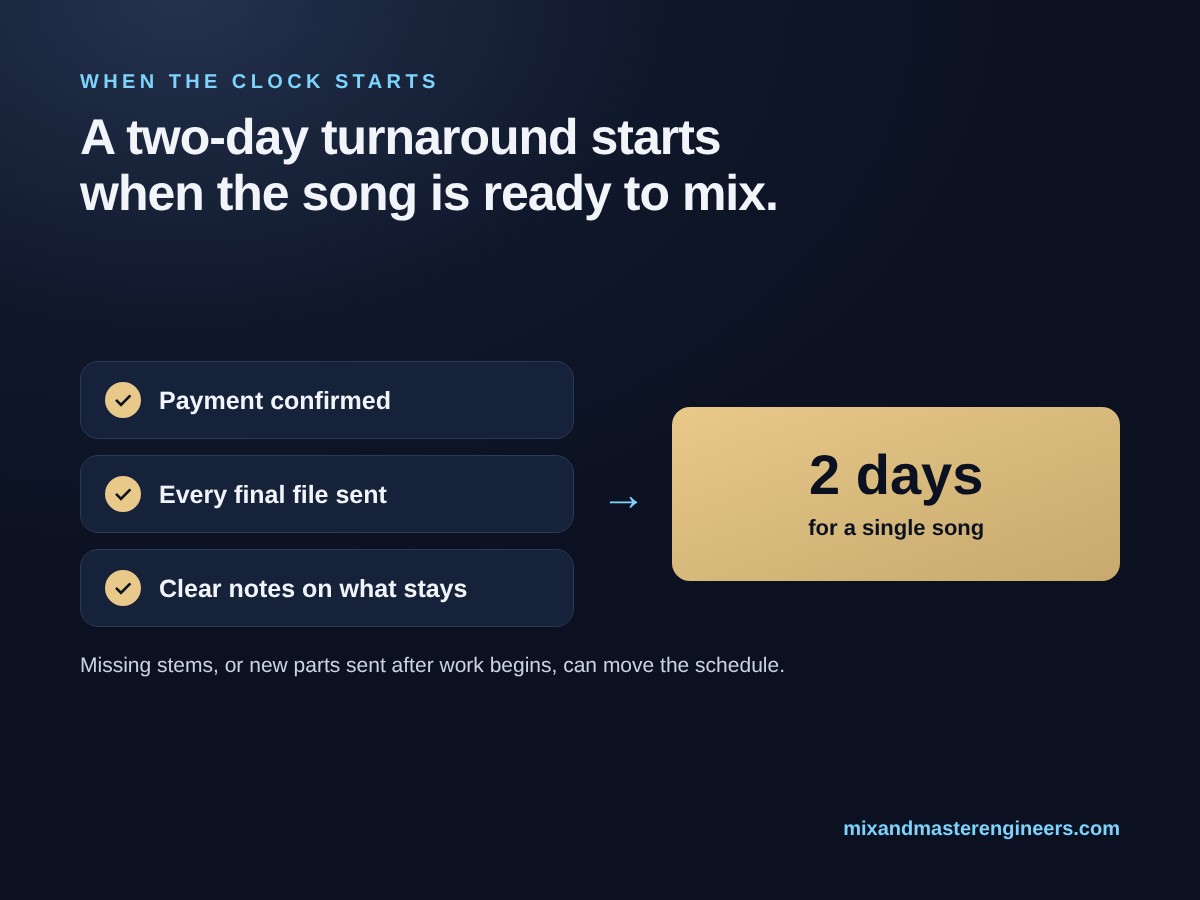
Once payment was confirmed and every final file had arrived, my two-day turnaround started. I organised the session, locked the lead vocal against the beat, then cleaned up the doubles and ad-libs so they gave the record energy without competing with the rapper's delivery. I sent the mix for review, made the requested final adjustments, and delivered the finished mix and master in time for the release upload.
That session is why I make the process clear from the beginning: a deadline is only realistic when the song is actually ready to be mixed. A two-day window is achievable for a single when the files, direction and payment are all in place. Incomplete files, or new parts sent after work begins, can change the schedule.
Plan the deadline before it becomes an emergency
A professional schedule protects both the music and the release campaign. If you have a fixed launch date, contact Mix & Master Engineers before the final production week. Include the number of songs, file status, services required and deadline so the studio can confirm a realistic plan.
You can also review the mixing service, mastering service, available packages and before-and-after examples. The best turnaround is not simply the shortest promise—it is the shortest schedule that still gives the record proper attention.
Keep reading
- Which files you get back after mixing and mastering
- How to prepare and export stems before booking a mix
- Gospel mixing and mastering
- Mixing and mastering for Nashville artists
---
About the author: Charles "DGUNZ" Alison is the lead mixing and mastering engineer at Mix & Master Engineers, with 15+ years of experience across hip-hop, Afrobeats, gospel, R&B, pop and more. He trained at Point Blank Music School (UK), is an approved Apple Digital Masters provider, and is a Top Rated, Vetted Pro engineer on Fiverr with 2,200+ client reviews. Meet the engineer · Contact the studio