

How to Choose a Mixing and Mastering Engineer for Your Music
Choose the right mixing and mastering engineer by evaluating sound, process, communication, deliverables and the needs of your particular release.
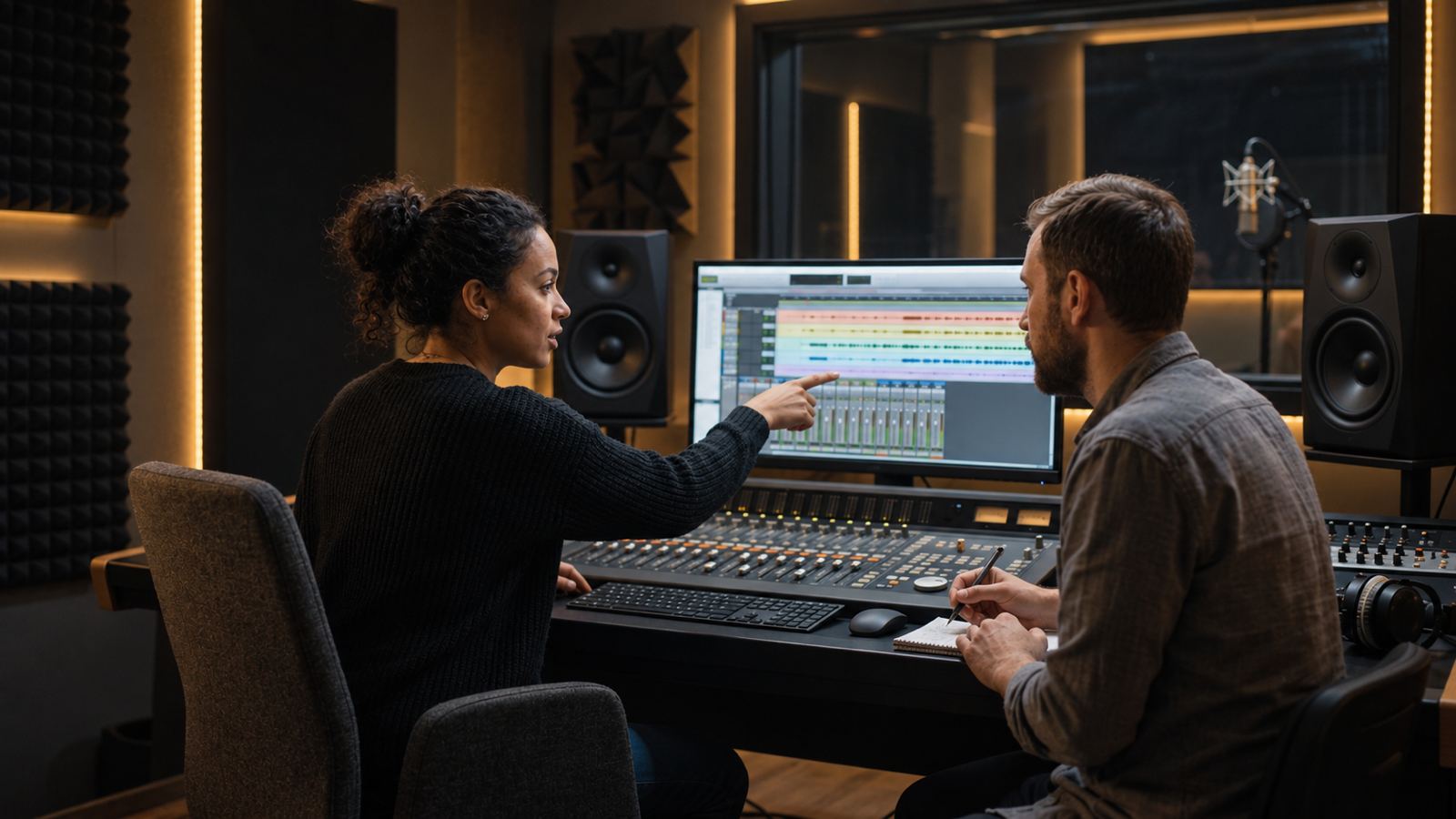
Choosing an engineer is not the same as choosing a plug-in or buying a preset. You are selecting a creative partner who will make hundreds of decisions about balance, tone, dynamics and presentation. The best choice is not automatically the most expensive person, the closest studio or the engineer with the largest social following. It is the person whose work, process and communication fit your music.
Use this guide to compare engineers carefully before sending a full project or paying for a service that does not match your needs.
Define the job before comparing providers
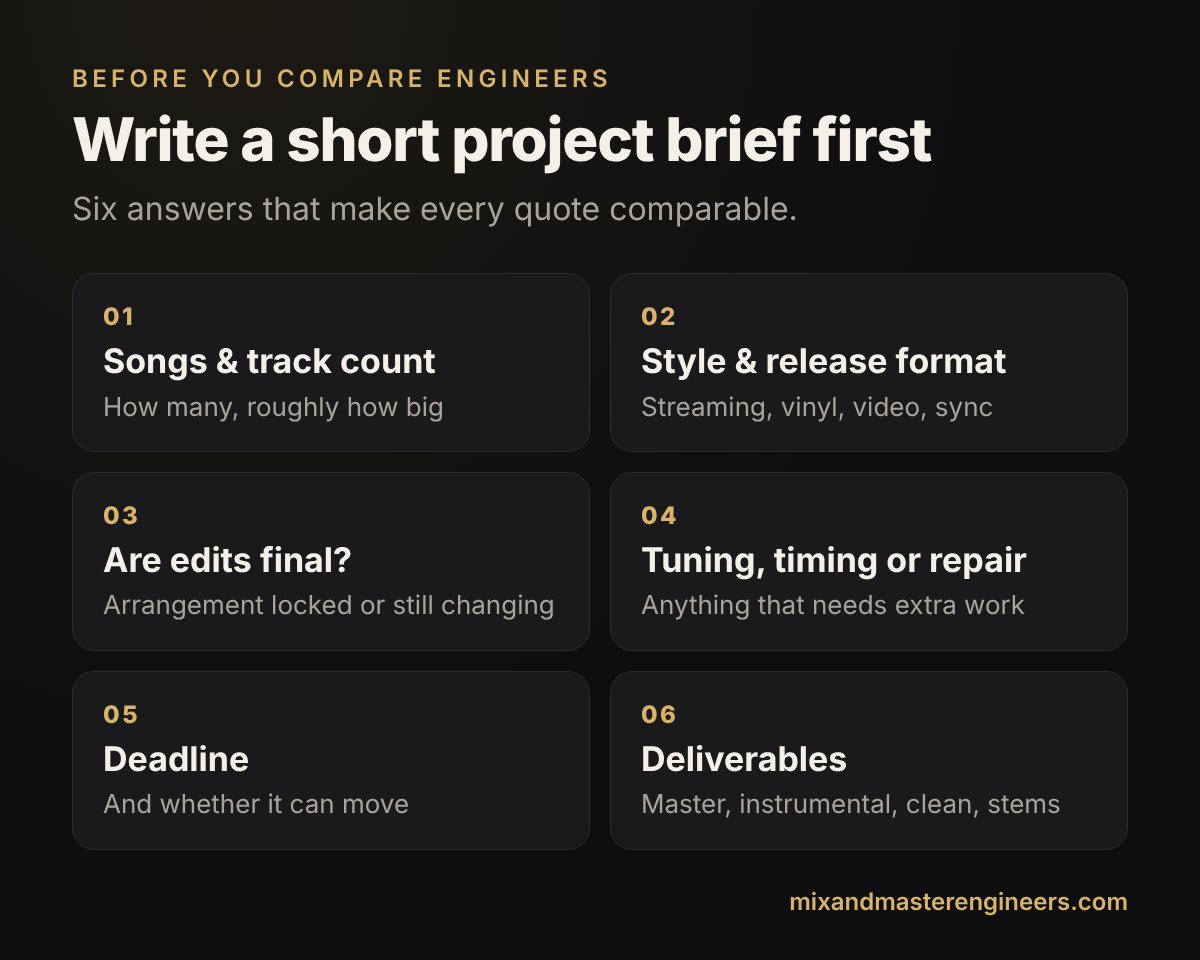
Start by deciding what stage your song has reached. Mixing combines and shapes the individual tracks. Mastering prepares an approved stereo mix for release. Vocal editing, pitch correction, drum editing, production changes and stem creation may be separate services.
Write a short project description that includes:
- The number of songs and approximate track count.
- The style and intended release format.
- Whether the arrangement and edits are final.
- Any vocal tuning, timing or noise-repair needs.
- Your preferred deadline and whether it is flexible.
- The deliverables you expect after approval.
This prevents price comparisons between packages that include different work. Our guide to what files you should receive after mixing and mastering explains common delivery options.
Listen to work that relates to your priorities
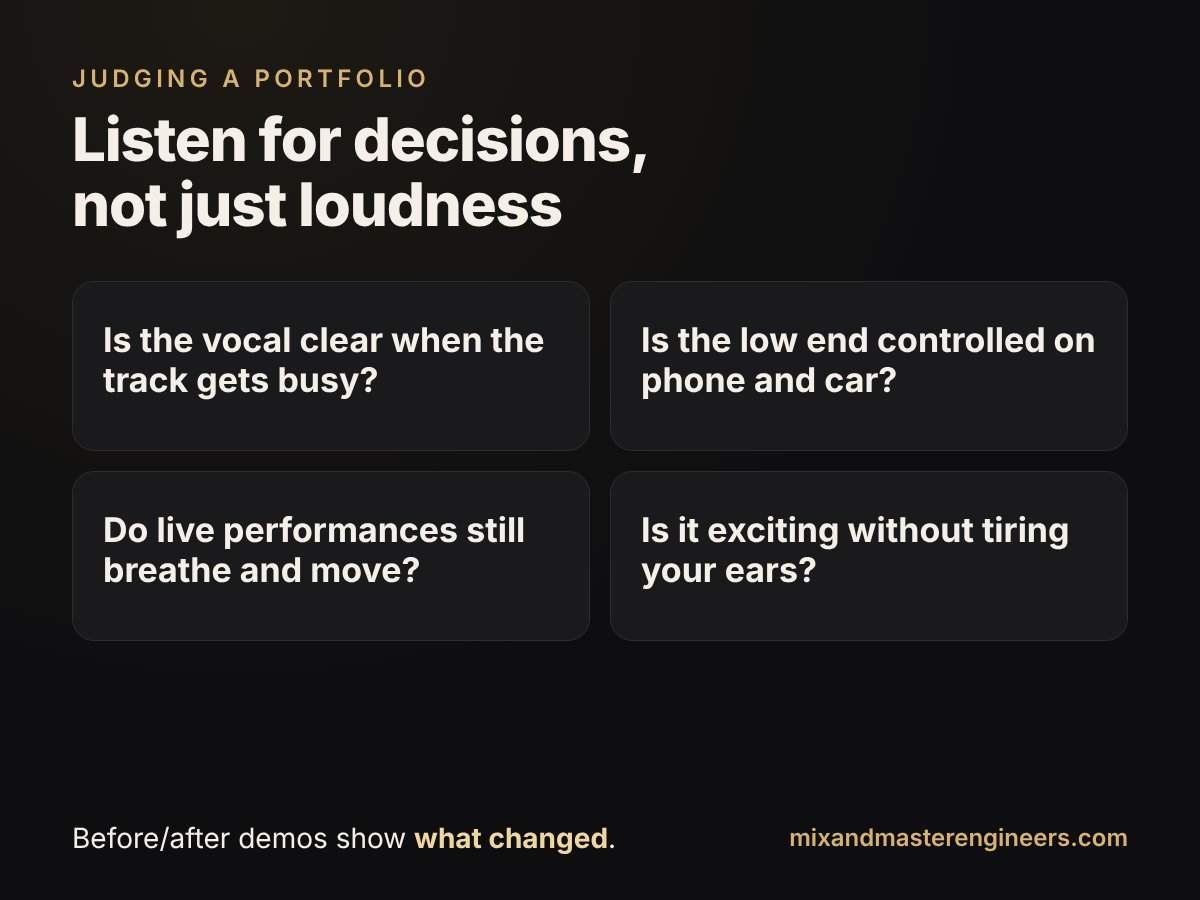
A portfolio should be judged for decision-making, not just volume. Listen on familiar headphones or speakers and focus on the qualities that matter to your song. Can you understand the lead vocal when the arrangement becomes busy? Does the low end feel controlled on more than one playback system? Do acoustic performances retain natural movement? Do aggressive productions remain exciting without becoming exhausting?
Genre experience can be helpful, but do not reduce the decision to a label. An engineer may understand vocal-forward records across several styles. Another may specialise in live drums, dense guitars or electronic low end. Ask for examples that demonstrate the specific challenge in your project.
Before-and-after examples are useful because they reveal how an engineer treats source material. Explore our mixing and mastering demonstrations and compare changes in clarity, depth, dynamics and emotional impact.
Assess communication before the project starts
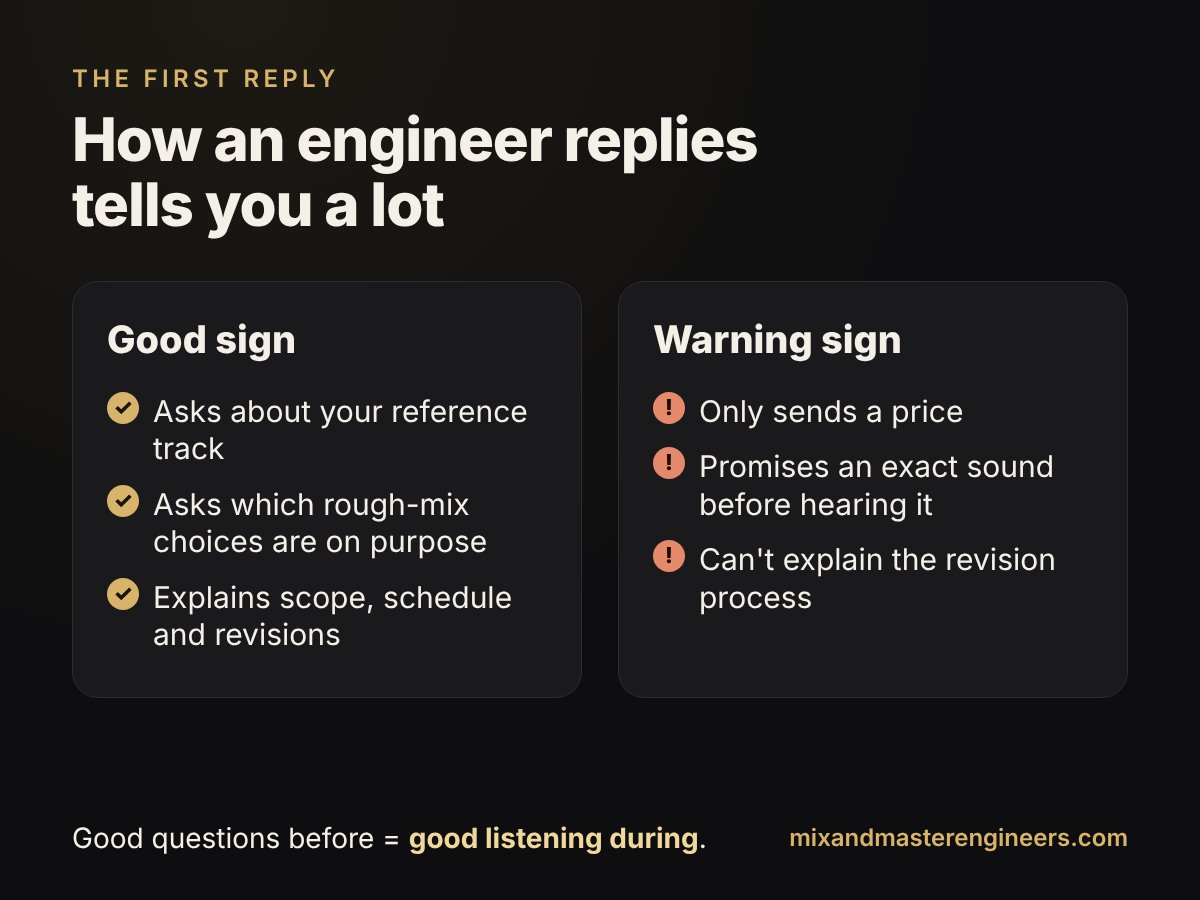
The first exchange often predicts the working relationship. A professional response should clarify the scope, delivery format, schedule and revision process. It should not promise an exact result without hearing the material.
Notice whether the engineer asks useful questions. They may want to know which rough-mix choices are intentional, which reference tracks matter and whether printed effects are essential. Clear questions show that the engineer is trying to understand the record rather than force it through a standard chain.
You should also be able to describe feedback in musical language. You do not need to identify a frequency or compressor setting. “The first verse feels too distant” or “the bass loses energy on small speakers” gives the engineer a meaningful direction.
Clarify revisions and approval
Revision policies vary. Ask how many rounds are included, what counts as a revision and how additional changes are priced. A mix revision adjusts an agreed direction. Replacing vocals, changing the arrangement or sending new production after the first mix may require additional work.
Agree on how feedback will be collected. One organised set of timestamped notes is usually more efficient than several conflicting messages. If several people must approve the record, nominate one contact who can combine their comments.
A good policy protects both sides. It gives the artist a clear opportunity to refine the work while preventing the project from becoming an undefined series of new creative directions.
Confirm deliverables and ownership
Ask which file formats, sample rates and versions are included. Depending on the project, you may need a full master, instrumental, performance or TV mix, clean edit, acapella, stems or alternate masters. Do not assume every version is included in the basic fee.
Clarify how long project files and exports are retained. Maintain your own backup of the source files and approved deliveries. An engineer should not be your only archive.
Read the terms covering payment, cancellation, credits and the permitted use of portfolio excerpts. If anything is unclear, ask before booking. Professional agreements are not a sign of distrust; they prevent avoidable misunderstandings.
Check file security and delivery workflow
Your unreleased music should be handled with care. Ask how files are uploaded, who can access them and how final versions are delivered. A secure client portal or controlled transfer system is preferable to links posted in public spaces.
File security also depends on your habits. Use clear filenames, keep local backups and avoid sharing account credentials. Confirm the final approved version before it is sent to a distributor.
Understand pricing without shopping by price alone
Low and high prices can both be misleading when viewed without scope. One quote may cover a straightforward stereo master; another may include editing, mixing, vocal tuning, alternate versions and several revision rounds.
Compare the complete service:
- What work is included?
- What must be prepared by the artist?
- How many revisions are allowed?
- Which deliverables are supplied?
- Is rush delivery available, and what does it change?
- Are taxes or payment fees stated clearly?
Choose a level that is sustainable for the release. Spending beyond your budget does not guarantee a hit, while choosing only the cheapest option can become expensive if the service must be repeated. Review our current packages and pricing for transparent scope information.
Evaluate credentials carefully
Training, certifications and professional credits can support trust, but they should be described accurately and should not replace listening. Look for evidence that relates to the claim being made. An impressive logo without context does not tell you how the engineer will treat your song.
Customer reviews can help when they discuss communication, consistency and the delivery process. Be cautious with claims that guarantee chart placement, streams or label attention. Engineering can improve presentation; it cannot promise an audience response.
Warning signs to take seriously
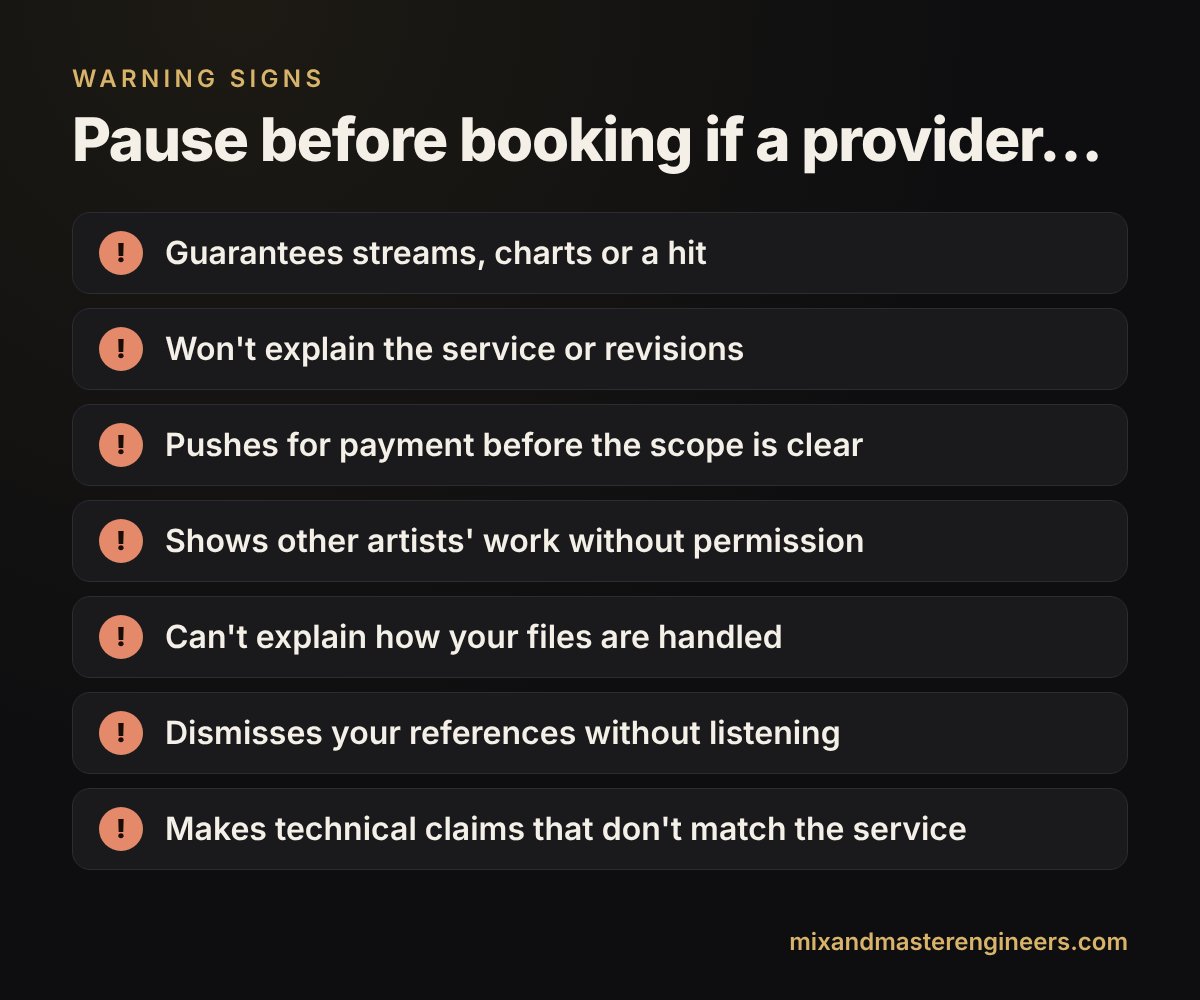
Pause before booking if a provider:
- Guarantees commercial success or a specific streaming result.
- Refuses to explain the service or revision policy.
- Pressures you to pay before confirming the scope.
- Uses another artist's work without clear permission.
- Cannot explain how files and deliverables are handled.
- Dismisses your creative references without listening.
- Offers technical claims that do not match the actual service.
One warning sign may have an innocent explanation, but unclear answers should be resolved before money or unreleased files change hands.
Frequently asked questions
Should mixing and mastering be done by the same engineer?
They can be, but they do not have to be. A separate mastering engineer offers another listening perspective, while one studio can provide a simpler coordinated workflow. Judge the quality, communication and scope rather than assuming one structure is always superior.
Should I ask for a free sample?
A short sample can help when the studio offers one, but it may not represent the complete process or final revision stage. Treat it as one part of your evaluation alongside full examples, terms and communication.
What should I send when requesting a quote?
Send a private rough mix, track count, service needs, deadline, release format and a concise description of any editing or tuning. Do not upload the entire multitrack until the studio confirms how it should be prepared.
From the studio: what I would ask if I were hiring
If I were an artist looking for an engineer, I would ask to hear work in my own style first. Someone who mixes great drill may not be the right fit for a soft R&B ballad, and the reverse is also true. Before-and-after demos tell you more than a finished track, because you can hear what the engineer changed.
Next, I would ask how revisions work and what files I get at the end. A clear answer shows the engineer has a process. A vague one often leads to confusion later.
I would also send a short test brief and see how the engineer replies. Do they ask about your reference, your release plan and your vocal sound? Or do they only send a price?
A client once sent me a famous artist's track and asked me to make his vocals sound exactly like it. His recording had distortion and clipping, so I told him honestly that I could remove the effects he didn't like and get as close as possible, but not an exact match. He agreed, then sent his notes with timestamps, such as "take the reverb off the ad-lib at 0:36" or "the vocals don't sync at 2:16". That made each revision faster. A good engineer tells you what's possible before you pay, not after.
I have been mixing for more than 15 years, and I still think the best working relationships start with good questions on both sides. If an engineer listens closely before the session, they will usually listen closely during it too. That matters more than any list of plug-ins.
Discuss your project with the studio
If you are comparing options, contact Mix & Master Engineers with your rough mix and project details. You can also review the service packages and client feedback before deciding. The aim is a clear working relationship in which the music, responsibilities and expected delivery are understood before the first mix begins.
Keep reading
- The files you should receive when a mix and master is finished
- Mixing versus mastering: what each step does
- R&B mixing and mastering services
- Mixing and mastering for Chicago artists
---
About the author: Charles "DGUNZ" Alison is the lead mixing and mastering engineer at Mix & Master Engineers, with 15+ years of experience across hip-hop, Afrobeats, gospel, R&B, pop and more. He trained at Point Blank Music School (UK), is an approved Apple Digital Masters provider, and is a Top Rated, Vetted Pro engineer on Fiverr with 2,200+ client reviews. Meet the engineer · Contact the studio